

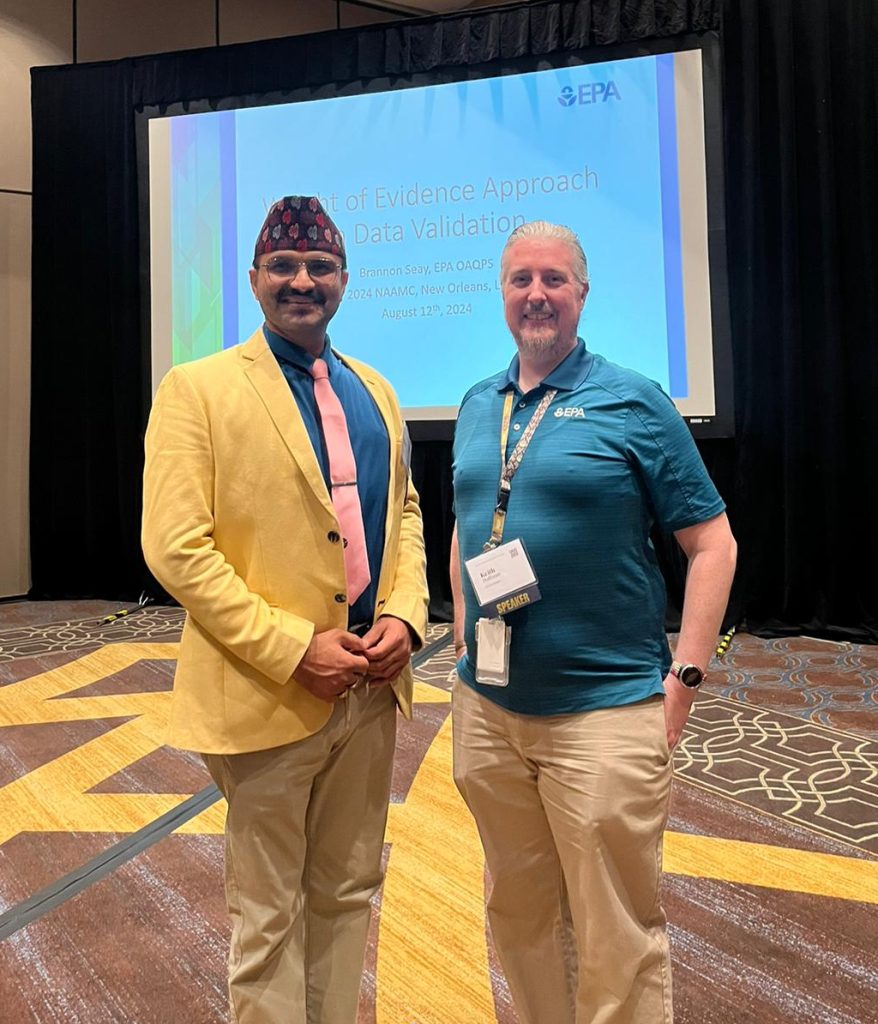
From New Orleans to Kathmandu: Shashi Sharma Majgainya Integrates U.S. EPA Insights into KMC Air Policy
NEW ORLEANS, USA — Representing Nepal’s environmental interests on a high-level global stage, Shashi Sharma Majgainya participated in the 2024 National Ambient Air Monitoring Conference held in New Orleans, Louisiana, this past August. Invited by the U.S. Environmental Protection Agency (EPA), Mr. Majgainya—who serves as the President of the National Federation of Youth NGOs Nepal (NFYN) and Aawaj International—joined a distinguished cohort of international experts and scientists to master advanced strategies for air quality monitoring and urban resilience.
During the summit, Mr. Majgainya shared a critical status report on the environmental challenges facing Kathmandu Metropolitan City (KMC). He detailed how Kathmandu frequently ranks among the world’s most polluted cities, with concentrations of fine particulate matter (PM2.5) often soaring ten to fifteen times above the World Health Organization (WHO) safe guidelines. His presentation emphasized that for a city like Kathmandu, air quality monitoring is not merely a technical exercise but a vital public health necessity to protect its millions of residents from respiratory and cardiovascular risks.
The conference provided a unique opportunity for Mr. Majgainya to acquire specialized technical skills and knowledge from the U.S. EPA’s Air Quality System (AQS). He focused on mastering high-fidelity sensor calibration, data verification protocols, and quality assurance (QA) standards. These insights are directly applicable to his ongoing work in Nepal, where he collaborates with global giants such as Bloomberg Philanthropies, Vital Strategies, and the WHO to operate a real-time air quality monitoring network across the capital. By integrating the U.S. EPA’s data-driven methodologies, he aims to shift local interventions from temporary, project-based efforts into a permanent, institutionalized national framework.
Beyond the technical sessions, Mr. Majgainya engaged in high-level strategic discussions with U.S. environmental experts and development agencies. He explored how the Clean Air Act model could inform Nepal’s own legislative efforts, particularly the Air Quality Management Procedure 2076. His participation ensures that Kathmandu’s strategy for environmental recovery is backed by world-class science and international best practices. As he returns to Nepal, Mr. Majgainya is poised to lead the implementation of these new skills, advocating for evidence-based policies that turn real-time data into a healthier, more breathable future for the global village.
